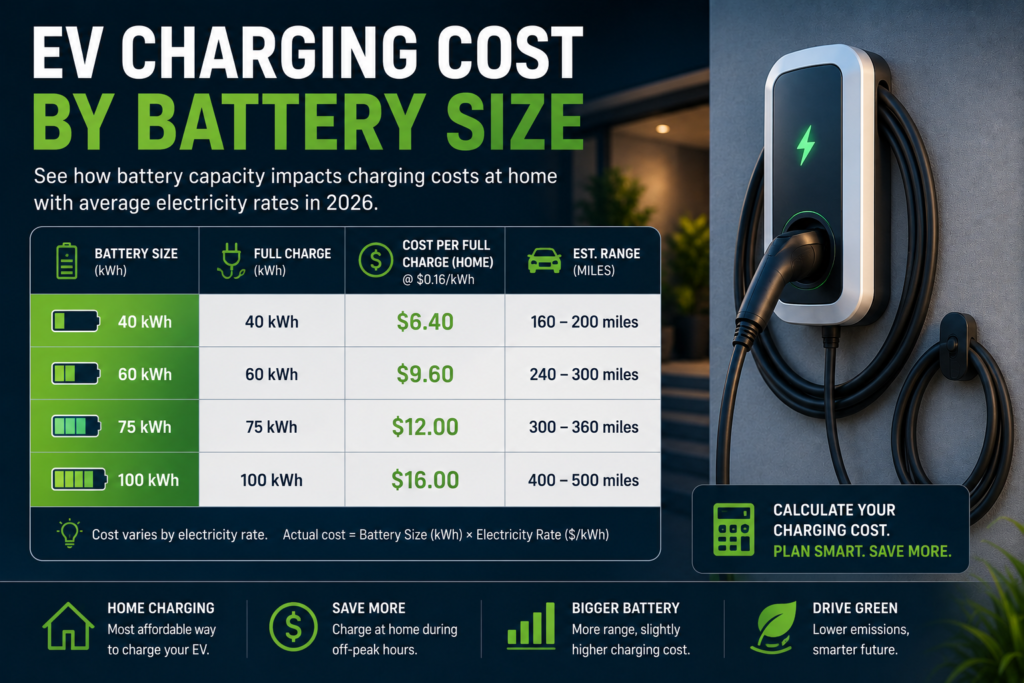

An EV charging cost by battery size comes down to one formula. Battery capacity, divided by charging efficiency, times your electricity rate. At 18.4 cents per kWh, the national average, a 66 kWh battery costs around $14 to fully charge. A larger 84 kWh pack runs closer to $18. Full-size electric trucks with 130-plus kWh batteries can cost $27 or more. Charging efficiency losses eat 10 to 15 percent of what you pay for. The real number always lands a bit higher than battery size times rate alone.
A charging cost calculator, no matter which one you use online, runs on the same three inputs. It needs your battery’s capacity, the efficiency of your charging setup, and the price you pay per kilowatt-hour. Once you know those three numbers, you don’t actually need a calculator at all.
The Formula, Broken Down
Battery capacity is usually listed in kilowatt-hours, or kWh. That’s the total energy the pack can hold, similar to how a fuel tank holds gallons. Automakers sometimes list two numbers: gross capacity and usable capacity. Usable capacity is always a bit smaller, since manufacturers reserve a buffer to protect the battery’s long-term health. For our calculations, use usable capacity when you can find it.
Charging efficiency is the part most online calculators skip entirely. Some energy gets lost as heat while your car converts AC power into DC power for the battery. Home Level 2 charging typically runs 85 to 90 percent efficient. Tesla’s own EPA certification data for the Model Y Performance shows a 14 percent loss in real-world testing.
The EPA’s own testing methodology confirms these losses are real. They’re baked into every efficiency rating, not just a manufacturer talking point. That means charging a 75 kWh battery from empty actually pulls closer to 85 kWh from your wall.
Electricity rate is the easiest number to find, and the one people most often get wrong. The US national average residential rate sits around 18.4 cents per kWh as of mid-2026. Your actual rate could be half that or triple it, depending on your state and utility. Check your last electric bill for your real per-kWh rate before trusting any generic calculator’s default number.
A Worked Example, Start to Finish
The table above assumes a full empty-to-full charge, but that’s not how most people actually drive. Say you own a Hyundai Ioniq 5 with the 84 kWh battery. You typically plug in overnight and charge from 20 percent up to 90 percent, not from empty.
First, find the kWh you actually need. That’s 70 percent of 84 kWh, or about 58.8 kWh. Next, account for charging losses. At a 12 percent loss on Level 2, you’ll draw closer to 66.8 kWh from your wall. That delivers the 58.8 kWh your battery actually needs. Finally, multiply by your rate. At 18.4 cents per kWh, that’s roughly $12.30 for the session.
That’s meaningfully less than the $18 our full-charge table shows for an 84 kWh pack. The gap is the whole point. Most real charging sessions are partial. So the “cost to fully charge” number is really a ceiling, not what you’ll typically pay.
Cost by Battery Size
Here’s how the math plays out across common battery sizes, using the national average rate.
| Battery Size Category | Example Models | Typical Pack Size | Cost to Fully Charge |
|---|---|---|---|
| Small (compact) | Chevy Bolt, Nissan Leaf | 40–66 kWh | $8–$14 |
| Mid-size (sedan/crossover) | Tesla Model 3/Y, Hyundai Ioniq 5 | 60–84 kWh | $13–$18 |
| Large SUV | Hyundai Ioniq 9, Rivian R1S | 90–120 kWh | $19–$25 |
| Full-size truck | Ford F-150 Lightning, GMC Hummer EV | 130–246 kWh | $27–$51 |
One honest caveat belongs here. Tesla has never officially published battery capacity for any current model. Every kWh figure for a Model 3 or Model Y comes from EPA filings, teardowns, or independent estimates. None of it comes from Tesla itself. Treat Tesla numbers as solid estimates, not confirmed specs.
Where You Live Changes the Math
Your state matters more than your car when it comes to charging cost. States with cheap hydroelectric power, like Washington and Idaho, often charge under 12 cents per kWh. Hawaii sits at the other extreme, with rates that can run past 40 cents per kWh. Its isolated grid is the reason why. That’s the difference between spending $8 to fully charge a small EV and spending $27 for the same battery. Your actual number depends far more on your utility bill than on which car you drive.
If you’re still deciding on a home charging setup, our EV charger installation cost guide can help.
Common Mistakes People Make With These Calculators
Most online calculators assume 100 percent charging efficiency, which inflates their accuracy and quietly understates your real bill. Many also assume you’re charging from completely empty to completely full every single time. In reality, most EV owners plug in around 20 percent and stop around 80 percent. That makes the real per-session cost smaller than the headline number most calculators show.
Another common mistake is using gross battery capacity instead of usable capacity. That single swap can overstate cost by several dollars per full charge. Plenty of calculators also default to a national average rate without asking where you live. That misses the regional swings we just covered above.
A third mistake is ignoring time-of-use pricing entirely. Many utilities charge different rates depending on the hour, sometimes three or four times more during peak evening hours. A flat national-average calculator can’t account for that swing. We’ll cover time-of-use charging savings in its own dedicated guide soon.
FAQ
Usually, yes, since cost scales directly with kWh capacity. A 246 kWh truck battery costs roughly six times more to fill than a 40 kWh compact car battery.
They’re usually using different assumptions for charging efficiency, electricity rate, or whether they use gross or usable capacity. None of that means one calculator is lying. They’re just filling in the blanks differently.
Not directly. A Level 1, Level 2, or DC fast charger all deliver the same energy for the same price. You’re billed by the kWh, not by the hour. Faster charging can slightly change efficiency losses, but the difference is usually small.
No. Tesla has never officially published kWh figures for its current lineup. Every number you see is a well-sourced estimate from EPA filings or independent testing.
Only if that’s actually how you charge. Most EV owners top off partially rather than running the battery down to empty first. Multiply your typical percentage gained, not the full battery size, for a more realistic number.
Check your latest electric bill, usually listed as cents per kWh, or dollars per kWh. Most utility websites also post current residential rates by rate plan.
No, a close estimate works fine for planning purposes. Your owner’s manual, window sticker, or the manufacturer’s official spec page usually lists it. When in doubt, use the category ranges in our table above.
Final Thoughts
An EV charging cost by battery size isn’t complicated once you see the formula behind it. Battery capacity, divided by charging efficiency, times your electricity rate, gets you within a dollar of the real number. The honest surprise for most people isn’t the battery size. It’s how much their own utility rate moves the final bill. Check your actual rate before trusting any calculator’s default number. Remember that most Tesla figures floating around online are estimates, not facts from Tesla itself.

Rana Muzammil is a Computer Science graduate and the founder of EVGroundTruth.com. He applies software analytics and data research to evaluate battery performance, charging infrastructure, and real-world EV metrics. His mission is to provide honest, fact-checked automotive insights free of marketing hype.