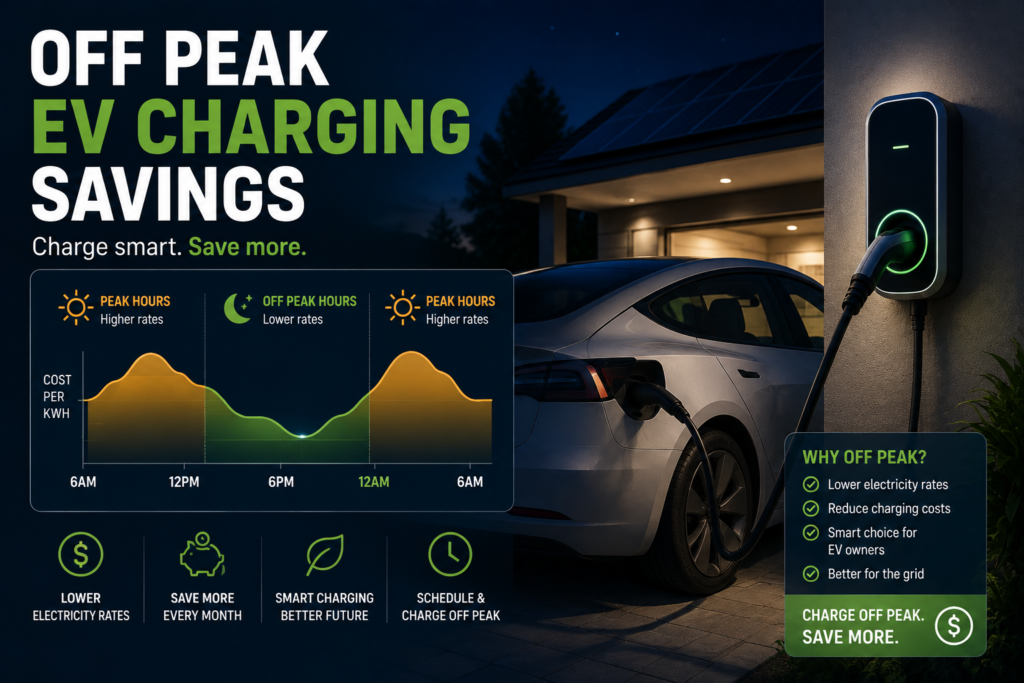

Off peak EV charging savings typically run 40 to 60 percent versus charging during peak hours. Most EV owners save $300 to $800 a year just by shifting when they plug in. A real example: charging a 60 kWh battery costs about $21.60 less at an off-peak PG&E rate. Savings vary a lot by utility, since off-peak windows and rate gaps aren’t standardized nationally. Some utilities offer 40 percent lower off-peak rates. Others, like PECO in Pennsylvania, cut rates by more than 75 percent overnight. We’ll break down real utility numbers below, not just national averages.
Off-peak simply means the hours when electricity demand, and therefore price, is lowest. Utilities charge more during peak hours because the grid strains to keep up. Rates drop overnight or midday, whenever demand falls. Off-peak EV charging savings come from lining your charging schedule up with those cheaper hours.
Why Off-Peak Rates Exist
Grid demand isn’t constant throughout the day. It spikes in the early evening, when people get home, cook dinner, and run air conditioning. Utilities have to build enough capacity to handle that peak, even though it only lasts a few hours. Off-peak pricing rewards you for using electricity when the grid has room to spare, and it’s cheaper to generate.
Smart meters make this pricing possible in the first place. Over 75 percent of US electricity meters are now smart meters, capable of tracking usage in 15-minute intervals. Without that kind of granular data, utilities can’t bill you differently by the hour.
Real Savings by Utility
Here’s what off-peak actually looks like at several major US utilities.
| Utility | Off-Peak Window | Off-Peak Rate | Peak Rate | Approx. Savings |
|---|---|---|---|---|
| PG&E (California) | 12am–3pm | $0.18–$0.22/kWh | up to $0.55–$0.58/kWh | ~60–65% |
| PECO (Pennsylvania) | 6am–2pm, 6pm–midnight | $0.076/kWh | $0.32/kWh (2–6pm) | ~76% |
| Georgia Power | Overnight, EV-specific plan | ~$0.08/kWh | ~$0.13–$0.14/kWh (standard) | ~40% |
| ConEd (New York) | Overnight | Roughly $0.15/kWh lower | — | Moderate |
| National trend | Nights and weekends, varies | 40–60% below peak | — | 40–60% |
Every utility sets its own hours and its own gap between peak and off-peak. Check your specific utility’s published rate schedule before assuming any of these numbers apply to you. PG&E’s own EV rate page is a good example of what that schedule actually looks like.
A Full Worked Example: One Month of Off-Peak Charging
Let’s run the actual math for a typical EV driver. Say you drive 1,000 miles a month in a vehicle that gets 3.5 miles per kWh. That works out to roughly 286 kWh of charging each month.
At PECO’s peak rate of 32 cents per kWh, that month costs $91.52. Shift that same 286 kWh to PECO’s off-peak rate of 7.6 cents instead. The same month costs just $21.74. That’s a savings of $69.78 in a single month. Over a year, that’s roughly $837, just from changing when you plug in.
How to Actually Charge Off-Peak
Knowing the rate gap doesn’t save you anything until you actually shift your charging time. Most home chargers, including basic plug-in Level 2 units, let you schedule a start time through an app. Set it for whenever your utility’s off-peak window begins, and walk away. Some utilities also run their own smart charging programs. These control your charger directly, and sometimes pay you a rebate for joining. If your utility doesn’t offer that, a $30 smart plug or outlet timer works almost as well. If you’re shopping for a charger with built-in scheduling, our EV charger installation cost guide can help.
EV-Only Plans vs. Whole-Home TOU
Some utilities offer EV-specific rate plans. These apply only to a dedicated charging circuit, metered separately from the rest of your house. Others put your entire home on time-of-use pricing, including your lights, your fridge, and your air conditioner. That distinction matters. An EV-only plan is close to a guaranteed win, since charging is easy to shift to any hour. Whole-home TOU can backfire if you can’t avoid peak-hour use, like running AC on a hot afternoon.
Renters and apartment dwellers face an extra hurdle. If you don’t control your own electric meter, enrolling in a TOU or EV-specific plan usually isn’t possible. Workplace charging or a public network becomes the more realistic savings lever in that situation.
For the full monthly picture, our guide on how much EV charging costs covers the total bill. <!– internal link opportunity: Article 5, “how much does it cost to charge an electric car,” once that URL is confirmed live –>
Common Mistakes People Make With Off-Peak Charging
The biggest mistake is assuming your utility offers off-peak pricing without checking. Not every utility does, and enrollment is often opt-in, not automatic. Another common mistake is forgetting that whole-home TOU plans penalize peak-hour usage you can’t avoid, like summer air conditioning. Some drivers also assume off-peak always means overnight. In states with heavy solar power, midday can be the cheapest window instead, thanks to abundant solar generation. Check your specific off-peak hours rather than assuming they match a typical night schedule.
FAQ
Most EV owners save $300 to $800 a year, depending on their utility’s rate gap. Utilities with the widest peak-to-off-peak spread, like PECO, can push savings even higher.
No. Over half of US electricity customers have access to a TOU plan, but it’s rarely automatic. You typically have to opt in through your utility’s website.
For EV charging specifically, almost always. Since you can freely choose when to plug in, shifting to off-peak hours has essentially no downside.
Most Level 2 chargers include an app with a scheduling feature built in. Set it once for your utility’s off-peak window, and it repeats automatically.
No, timing doesn’t change how charging affects your battery. The only thing that matters for battery health is charging speed and pack fullness. The hour on the clock has nothing to do with it.
Check if they offer a general residential TOU plan instead. The savings won’t be quite as targeted, but shifting your EV charging to the off-peak window still helps.
You need to actively enroll in a TOU or EV-specific plan first. Simply charging at night on a flat-rate plan won’t save you anything. The rate stays the same all day regardless of when you plug in.
Final Thoughts
Off-peak EV charging savings are one of the easiest wins in the entire EV ownership picture. There’s no equipment to buy and no driving habit to change, just a scheduling setting. The honest caveat is that whole-home TOU isn’t automatically a win if you can’t shift other usage. For EV charging specifically, though, the math almost always favors switching. Check your utility’s actual rate schedule, set your charger’s timer once, and the savings happen automatically from then on.

Rana Muzammil is a Computer Science graduate and the founder of EVGroundTruth.com. He applies software analytics and data research to evaluate battery performance, charging infrastructure, and real-world EV metrics. His mission is to provide honest, fact-checked automotive insights free of marketing hype.