
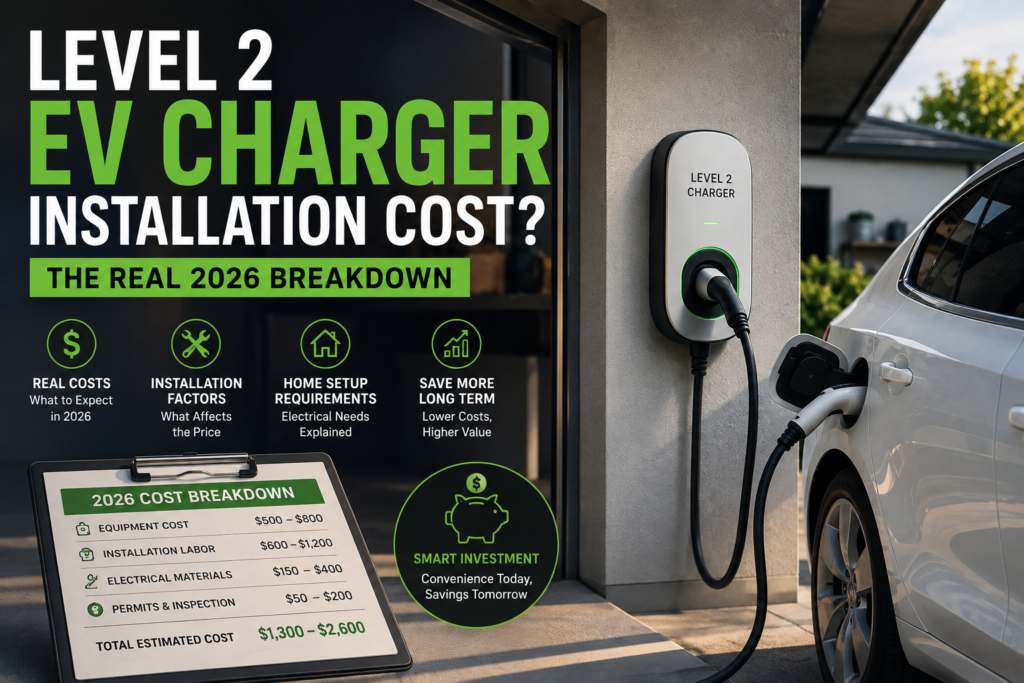

Quick answer: Level 2 EV charger installation cost runs $800 to $2,500 for most homes, all-in. A simple job with no panel upgrade lands closer to $800–$1,600. A panel upgrade or a long wiring run can push the total to $3,000–$6,000 or more. Your panel’s capacity is the single biggest factor, not the charger brand.
Most cost guides bury the one thing that actually matters. Two homeowners can buy the exact same charger and pay wildly different totals. The gap almost never comes from the hardware. It comes from what’s already inside the electrical panel. So we will also Cover cost to install level 2 charger at home with a complete Breakdown.
What Actually Goes Into This Price
Four separate costs stack up to build your total. Understanding each one tells you where your own quote is likely to land.
The Charger itself (EVSE).
Entry-level 32-amp units, like a Grizzl-E or AmazingE, run $200–$350. Mid-range 48-amp Wi-Fi models — JuiceBox, ChargePoint Home Flex, Emporia — run $350–$600. Premium units, like a Tesla Wall Connector or Wallbox Pulsar Plus, run $600–$900. Most homeowners land in the $350–$500 range. That’s enough to fully charge most EVs overnight.
Electrician Labor.
A straightforward job takes 2 to 4 hours. At typical 2026 rates of $80–$150 an hour, that’s $160–$600 in pure labor. Add materials and a service-call minimum, and a simple job runs $400–$800 total.
The Permit.
Nearly every US jurisdiction requires a permit for a new 240-volt circuit. Expect $50–$300, usually handled by your electrician as part of the quote.
Panel work, if you need it.
This is where costs jump. A 100-amp panel with no open breaker space often needs an upgrade to 200 amps. That alone runs $1,000–$4,000, sometimes more. A licensed electrician should check your panel before you buy anything.
Three Real-World Cost Scenarios :
| Scenario | What’s Involved | Typical Total |
|---|---|---|
| Simple install | Panel has capacity, charger near panel, indoor | $800–$1,600 |
| Medium complexity | Longer wire run, or outdoor weatherproofing needed | $1,500–$3,000 |
| Panel upgrade or trenching | 100A-to-200A upgrade, or a run to a detached garage | $3,000–$6,000+ |
Your home’s actual electrical setup decides which row applies to you. No charger brand changes that.
The Federal Tax Credit Everyone Still Mentions Is Gone
The federal 30C Alternative Fuel Vehicle Refueling Property Credit used to cover 30% of your cost. Up to $1,000. Plenty of guides still tell you it runs through 2032. It doesn’t anymore.
The One Big Beautiful Bill Act moved the residential deadline up to June 30, 2026. That’s confirmed directly by the IRS. If your charger wasn’t placed in service by that date, you can’t claim it. As of today, that window has already closed for homeowners.
Worth noting: even while it existed, this credit only applied to specific low-income or non-urban census tracts. Not every home qualified anyway.
Some utilities still run their own local rebate programs, separate from this federal credit. Check with your provider directly, since those vary by state and change often.
Hardwired vs. Plug-In: Does It Change the Cost?
Not by much. A plug-in setup uses a NEMA 14-50 outlet, the same 240-volt outlet used for RV hookups and electric ranges.
Hardwiring skips the outlet and wires the charger directly to the circuit.
Material cost is close to identical either way. Hardwiring is often the better long-term choice. Fewer loose connections, easier outdoor weatherproofing, more stable for daily heavy use.
Plug-in setups make sense if you might swap chargers later. Or if you want to unplug and travel with a portable unit.
Common Mistakes That Blow Up the Budget
Buying the charger before checking the panel.
A licensed electrician needs to assess your panel’s capacity first. Buying a 48-amp unit only to learn your panel can’t support it wastes money and delays the job.
Skipping the permit.
It’s tempting, but skipping it risks a failed inspection later. It can also mean insurance issues if there’s ever an electrical fire. The inspection verifies wire gauge, breaker sizing, and proper grounding.
Assuming the cheapest quote is the best one.
Pricing can vary 40% between electricians for the identical job. Get three quotes. Ask each one to specify wire gauge, breaker size, and whether a panel upgrade is included.
Forgetting load management as a cheaper alternative.
If a full panel upgrade feels like overkill, there’s a cheaper option. A load management device ($150–$300) lets a Level 2 charger share a circuit safely — no panel swap needed.
FAQ
Most homeowners pay $800 to $2,500 all-in. Simple jobs without a panel upgrade often land closer to $1,200.
Only if your panel lacks capacity or open breaker space. Many 200-amp panels handle a new circuit with no upgrade needed at all.
No, not for homeowners. The 30C credit expired for residential installs on June 30, 2026, under the One Big Beautiful Bill Act.
Not safely, and not legally in most areas. DIY work on a 240-volt circuit can void your insurance and will fail inspection almost everywhere.
A simple job takes 2 to 4 hours of electrician time. Complex jobs with panel work or trenching can take a full day or require two visits.
Final Thoughts
The honest version of Level 2 EV charger installation cost isn’t a single number. Anyone quoting a flat price without seeing your panel first is guessing. Get an electrician to look at your setup before you buy a charger, not after. That one step decides whether you land in the $800 range or the $4,000 range. No brand comparison will ever matter as much.

Rana Muzammil is a Computer Science graduate and the founder of EVGroundTruth.com. He applies software analytics and data research to evaluate battery performance, charging infrastructure, and real-world EV metrics. His mission is to provide honest, fact-checked automotive insights free of marketing hype.

Pingback: DeWalt Level 2 48-Amp Smart EV Charger Review (2026)
Pingback: EV Charger Installation Cost: What You'll Actually Pay in 2026
Pingback: EV Charging Cost by Battery Size: The Real Formula
Pingback: Off Peak EV Charging Savings: The Real Numbers by Utility 2026
Pingback: How Much Does EV Charging Add to Your Electric Bill?