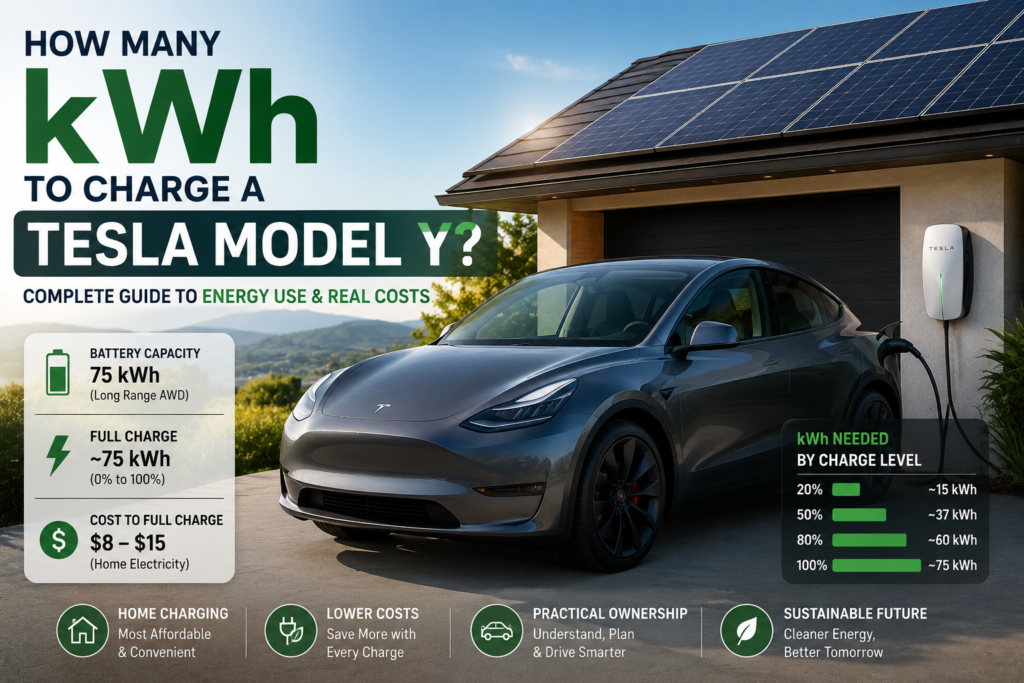

Quick answer: A 2026 Tesla Model Y needs roughly 60 to 82 kWh for a full charge from empty. The exact number depends on the trim. Standard models sit near the low end. Long Range and Performance sit near the high end. We’ll break down each one below, and show you what it actually costs.
So the how many kwh to charge a tesla model y consumes we will discuss on the fact bases as Tesla doesn’t publish official battery capacity numbers. Never has.
So every figure here — ours included — comes from EPA filings, teardown data, and real-world tests. Not a spec sheet Tesla hands out. We’ll flag where the numbers are estimates.
kWh by Trim: The Full 2026 Model Y Breakdown
Here’s how many kWh to charge a Tesla Model Y across the current lineup, from empty to 100%.
The Standard RWD carries an estimated 60 kWh of usable battery. It’s the smallest pack in the lineup, and it’s also the most efficient trim Tesla sells. EPA-rated range lands around 321 miles.
The Premium, in both RWD and AWD form, steps up to roughly 75 kWh usable. Range comes in around 327 miles. That’s slightly better than you’d expect for the extra battery — the newer aerodynamic redesign helps here.
Long Range AWD carries an estimated 78 kWh usable. This is the trim most road-trippers land on. It balances range against charging speed better than the Performance model does.
Performance AWD tops the lineup at roughly 82 kWh usable. More battery doesn’t mean more range here, though. The extra weight and stickier tires actually pull EPA range down toward 300 miles.
None of these numbers are exact. Ask ten different EV outlets and you’ll get ten slightly different figures. What matters more than the decimal point is which bracket your trim falls into. That’s what drives your real charging time and your electricity bill.
Full Charge Time by Trim (Home vs. Fast Charger)
Kilowatt-hours tell you how much energy your car needs. They don’t tell you how long that actually takes. And that varies a lot, depending on where you’re plugging in.
At home, every current Model Y trim caps its AC charging at 11.5 kW. That’s the ceiling, no matter how big your home circuit is. A 48-amp Level 2 charger on a 60-amp breaker gets you there. Bigger wiring won’t charge the car any faster than that.
On a Tesla Supercharger, DC charging peaks between 225 kW and 250 kW depending on trim. But peak speed is misleading — every EV tapers hard past 50% charge. In practice, 10% to 80% takes around 30 to 33 minutes across the lineup. That’s not the blazing number in Tesla’s marketing.
What It Actually Costs to Charge a Model Y
The national average residential electricity rate sits at about 18 cents per kWh as of mid-2026, per the U.S. Energy Information Administration. Multiply that by your trim’s kWh figure, and you get a real cost estimate:
Trim Est. Usable Battery Full Charge Cost (Nat’l Avg.) EPA Range
Standard RWD 60 kWh ~$11.06 321 mi
Premium (RWD/AWD) 75 kWh ~$13.83 327 mi
Long Range AWD 78 kWh ~$14.38 327 mi
Performance AWD 82 kWh ~$15.12 ~300 mi
That table only tells half the story, though. Electricity rates swing wildly by state, and the difference is bigger than most people expect. Idaho residents pay around 12 cents per kWh. Hawaii residents pay more than four times that, near 52 cents. That’s a real gap, confirmed by state-level EIA rate data.
Run the Long Range AWD’s 78 kWh through both extremes, and the picture gets stark. In Idaho, a full charge runs about $9.63. In Hawaii, the same charge costs roughly $40.56. Same car, same battery — more than four times the price, just because of where it’s plugged in.
If you don’t know your own state’s rate, check your last electric bill. Most utilities list the per-kWh price right on your statement. That number matters more than any national average we could give you.
Mistakes People Make Estimating This
Assuming a full charge every night. Most owners don’t actually charge from empty to 100% daily. Daily driving eats maybe 10 to 15 kWh, not the full 60 to 82. Your real monthly cost is almost certainly lower than the “full charge” math suggests.
Confusing nominal capacity with usable capacity. Battery packs always carry a buffer the car won’t let you touch, to protect long-term health. A “78 kWh” battery might only deliver 75 kWh you can actually use. This guide uses usable figures throughout, but plenty of sites mix the two without saying so.
Ignoring charging losses. Energy gets lost as heat between the wall and the battery — typically 10 to 15%. If you’re calculating your bill from the car’s own kWh readout, expect a slightly higher real cost.
FAQ
Between about 60 kWh (Standard RWD) and 82 kWh (Performance AWD), depending on trim.
No. Tesla has never released official battery capacity figures for any trim. Every number in circulation, including ours, comes from third-party testing and EPA data.
At the national average rate — about 18 cents per kWh — expect $11 to $15, depending on trim. Your actual cost depends entirely on your local electricity rate.
Home charging is almost always cheaper. Supercharger pricing runs well above residential rates in most states. It’s built for road trips, not daily use.
No. A full charge uses the same amount of energy whether it takes 30 minutes or 8 hours. Speed changes convenience, not total kWh consumed.
Final Thoughts
The honest answer to “how many kWh to charge a Tesla Model Y” isn’t one number. It’s a range. And it depends on the trim you pick at purchase. Here’s what we’d tell a friend shopping right now: don’t buy extra battery you don’t need. Don’t chase a bigger number on a spec sheet. Most daily driving barely touches a third of any of these packs. The bigger factor in your real-world cost is your electricity rate, not your trim. That’s the one thing worth checking first.

Rana Muzammil is a Computer Science graduate and the founder of EVGroundTruth.com. He applies software analytics and data research to evaluate battery performance, charging infrastructure, and real-world EV metrics. His mission is to provide honest, fact-checked automotive insights free of marketing hype.