
If you’re trying to figure out your real EV home charging cost before you plug in for the first time, you’re not alone. it’s one of the most searched questions among new EV owners, and honestly, most of the answers online are either too vague (“it depends!”) or built around one brand only. This guide — and the calculator above — breaks the number down properly: by your car, your charger, your state’s electricity rate, and even how it compares to what you’d pay at the gas pump.
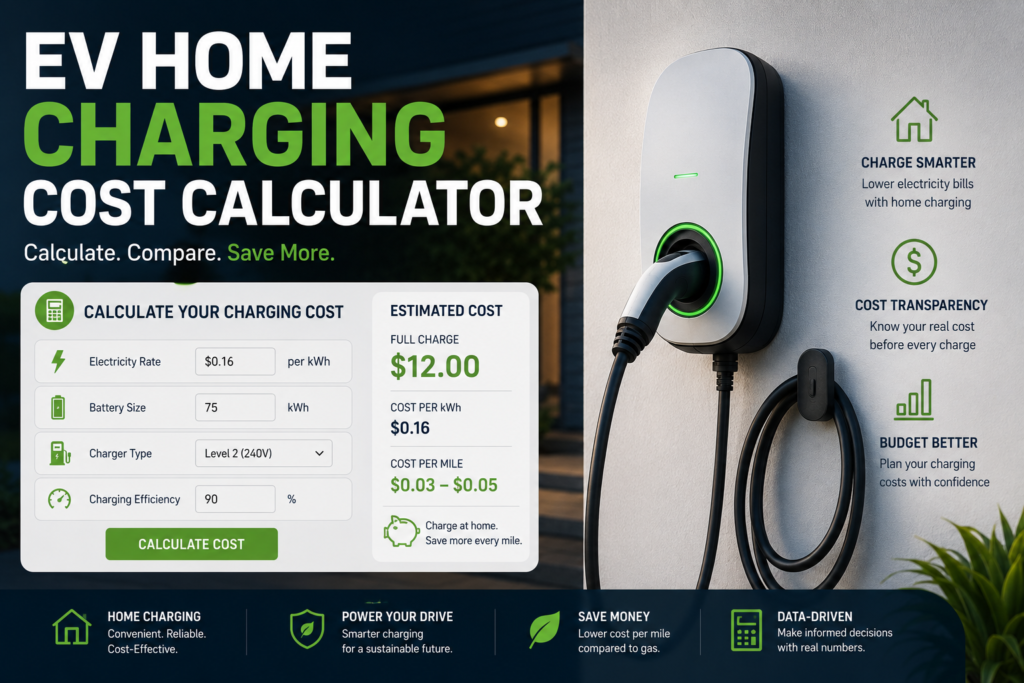
Use the calculator below to pick your vehicle, your home charging setup, and your local rate to see the real cost per charge, plus how it stacks up against filling a gas tank.
EV Home Charging Cost Calculator
Pick your EV, your home charger, and your electricity rate — see the real cost, and how it stacks up against a gas car.
What Determines Your EV Home Charging Cost?
Your EV home charging cost comes down to a simple formula: how many kilowatt-hours (kWh) you put into the battery, multiplied by what you pay per kWh. That’s it. There’s no hidden markup, no “charging fee” the way public networks sometimes add — at home, you’re paying your regular household electricity rate.
Three things move that number up or down:
- Battery size — a Tesla Model Y (75 kWh) needs more energy to fill than a Nissan Leaf (40 kWh)
- How empty you start — charging from 20% to 90% costs less than 5% to 100%
- Your electricity rate — this is the one most people underestimate, and it swings your bill more than anything else on this list
Average EV Home Charging Cost by State
This is where most online calculators fall short — they quote a single national number and call it a day. In reality, your EV home charging cost can be three times higher or lower depending on where you live, because electricity rates vary that dramatically across the U.S.
Based on current EIA residential rate data, the U.S. average sits around 17.9 cents per kWh — but:
- In North Dakota, Utah, and Washington, rates run closer to 11–12 cents/kWh, meaning a full charge on a 60 kWh battery costs around $7
- In California and Massachusetts, rates climb above 30 cents/kWh — the same charge jumps to roughly $19
- Hawaii sits at the extreme end, over 41 cents/kWh, pushing that same charge past $24
That’s not a small gap. If you drive the U.S. average of about 1,000 miles a month, the difference between a cheap-rate state and an expensive one can add up to hundreds of dollars a year — which is exactly why the calculator above lets you select your actual state instead of guessing from a national average.
EV Home Charging Cost vs. Gas: The Real Comparison
This is the number most people actually want to know: is charging at home genuinely cheaper than gas, or is that just marketing?
Based on current numbers — a national average electricity rate of roughly 17.9 cents/kWh against a national average gas price of about $4.10/gallon — a typical EV costs somewhere between 4 and 6 cents per mile to run at home. A comparable gas car averaging 32 MPG costs around 13 cents per mile at the pump.
That works out to home charging being roughly 50–65% cheaper per mile than gas, depending on your specific vehicle and local electricity rate. Over 1,000 miles a month, that can mean $80–$100 in monthly savings — which is exactly what the calculator’s EV-vs-gas comparison bar shows you in real time.
FAQ
At the U.S. average residential rate of about 17.9 cents per kWh, fully charging a typical 60 kWh EV battery costs roughly $10.75. The exact cost depends on your battery size and your state’s electricity rate — use the calculator above with your own numbers for an exact figure.
Yes, in almost every state. At the national average electricity rate, home charging costs around 5 cents per mile, compared to roughly 13 cents per mile for a 32-MPG gas car at current gas prices (~$4.10/gallon). That’s typically 50–65% cheaper per mile, though the exact gap depends on your local electricity rate and the gas car you’re comparing against.
North Dakota, Utah, and Washington have the lowest residential electricity rates, around 11–12 cents per kWh — charging a 60 kWh battery there costs about $7. Hawaii is the most expensive at roughly 41 cents per kWh, pushing the same charge to about $25. Most states fall between 12 and 20 cents per kWh.
No — the total cost to charge is based on the kilowatt-hours delivered, not how fast they’re delivered. A Level 2 charger fills the same battery in a fraction of the time but costs the same as a Level 1 outlet for the same amount of energy. Faster charging saves time, not money.
The formula is: (kWh added to the battery) × (your electricity rate per kWh) = total cost. kWh added depends on your battery size and the percentage you’re charging from and to. This is exactly what the calculator above does automatically.
Why This Calculator Beats a Generic Estimate
Most home charging calculators online are built around a single vehicle brand and a static, outdated rate table. This one is different: it covers multiple EV brands and models, pulls current state-level electricity rate data, lets you toggle off-peak rates, and — most usefully — shows your EV home charging cost side-by-side against an equivalent gas car, so you’re not just seeing a number in isolation, you’re seeing what it actually means for your budget.
Plug in your own vehicle, your own state, and your own driving habits above, and you’ll have a far more accurate picture of your real EV home charging cost than any flat, one-size-fits-all number could give you.

Rana Muzammil is a Computer Science graduate and the founder of EVGroundTruth.com. He applies software analytics and data research to evaluate battery performance, charging infrastructure, and real-world EV metrics. His mission is to provide honest, fact-checked automotive insights free of marketing hype.