
Quick answer: A full charge costs about $10 to $22, depending on your car’s battery size. Most drivers spend roughly $50 to $80 a month charging at home. Switch to an off-peak utility rate, and both numbers can drop by half or more. We’ll show exactly why below.
Ask five people how much it costs to charge an electric car, and you’ll get five different answers. That’s not because anyone’s wrong. It’s because the real number depends on three things. Your battery size, your electricity rate, and what time of day you plug in. Get specific about those three, and the guesswork disappears.
It Depends on Battery Size More Than Anything Else
The average battery in a new US electric car reached about 90 kWh in 2026. That’s according to the International Energy Agency. But that average hides a huge range. Compact EVs run much smaller. Large SUVs and trucks run much bigger.
For cost purposes, it’s easier to think in three tiers. Compact EVs, like a Chevy Bolt or Nissan Leaf, carry around 55 kWh usable.
Mainstream midsize EVs and crossovers, like a Tesla Model 3 or Hyundai Ioniq 5, carry around 75 kWh. Large SUVs and trucks, like an F-150 Lightning or Rivian, often carry 120 kWh or more.
Bigger batteries don’t always mean bigger cost per mile, though. A heavier SUV can use nearly twice the energy per mile of an efficient sedan. Even with a similar-sized battery. Size and efficiency both matter here.
What a Full Charge Actually Costs?
Here’s the formula behind every number in this article: usable kWh × your electricity rate = cost. The national average residential rate sits at about 18.4 cents per kWh in 2026.
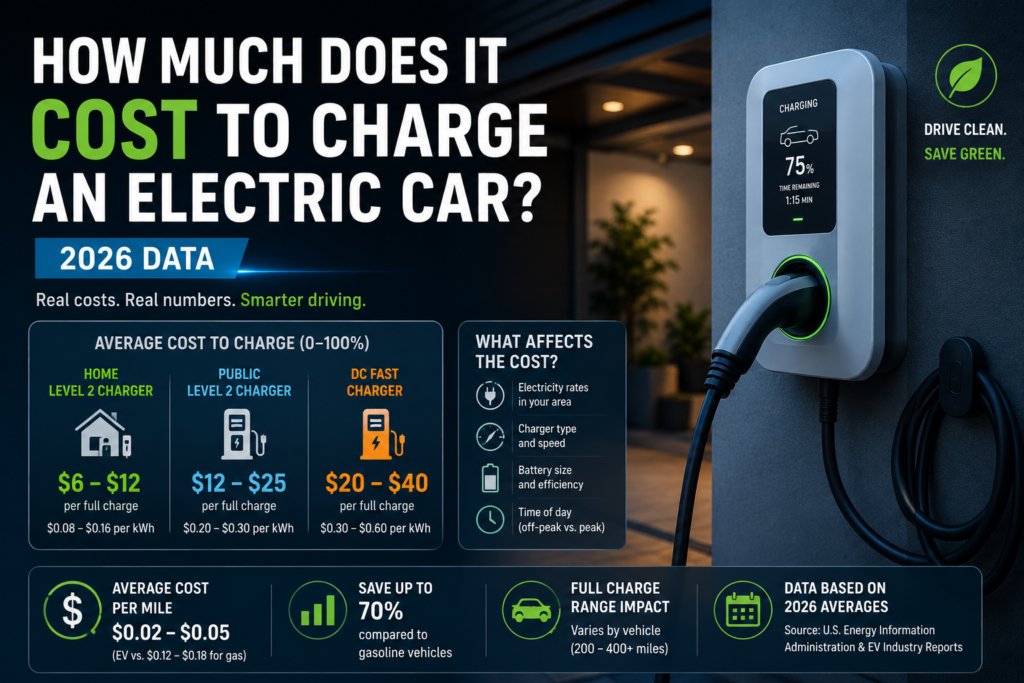
Run that through all three battery tiers. A full charge from empty costs roughly $10 for a compact EV. Midsize EVs run about $14, and large SUVs or trucks run about $22.
Those numbers use the national average, though. Your actual rate could be quite different. Electricity prices vary a lot by state. They vary even more by time of day that’s where the real savings live.
The Trick Most Guides Never Mention: Off-Peak Rates
This is the section that actually separates a good EV cost guide from a lazy one.
Most utilities now offer time-of-use pricing. Electricity costs far less overnight than during early evening peak hours. SDG&E’s current EV rate plan charges just 13.1 cents per kWh overnight.
Peak hours run 80.2 cents — a six-times difference. Georgia Power’s Overnight Advantage plan works the same way. It’s built to reward EV owners who charge late at night.
Run the math on a midsize EV. At the national average, a full charge runs about $14. At a solid off-peak rate around 10 cents per kWh, that same charge drops to roughly $7.50. Half the cost, same car, same electricity — just a different few hours on the clock.
Most modern chargers and EVs let you schedule charging automatically. Set it once for the middle of the night, and you never have to think about timing again.
What You’ll Actually Spend Per Month
A full-charge number is useful, but most people want to know their real monthly cost.
The average US driver covers about 1,000 miles a month. At the national average rate, that lands around $48 a month for a compact EV.
Midsize EVs run about $56, and large SUVs or trucks run about $80. Shift that same driving to off-peak hours, and those numbers fall to roughly $26, $30, and $44.
Compare that to a gas car. Today’s national average gas price is about $4.10 a gallon. A 30-mpg car covers that same 1,000 miles for about $137. Even at the national average electricity rate, EV charging beats that by a wide margin. On an off-peak plan, the gap gets enormous.
Home vs. Public Charging Cost Comparison
| Charging Method | Compact (~55 kWh) | Midsize (~75 kWh) | Large SUV/Truck (~120 kWh) |
|---|---|---|---|
| Home, national avg (18.4¢) | ~$10 | ~$14 | ~$22 |
| Home, off-peak (~10¢) | ~$5.50 | ~$7.50 | ~$12 |
| Public DC fast charging (~31-37¢) | ~$17-20 | ~$23-28 | ~$37-44 |
Public fast charging costs more everywhere, on every vehicle size. It’s built for road trips and top-ups, not your everyday routine.
Common Mistakes People Make Estimating This
Using one flat number for every EV.
A compact hatchback and a full-size electric truck don’t cost the same to charge. Battery size changes the math too much to ignore.
Never checking for a utility EV rate plan.
Many electricity providers offer EV-specific off-peak pricing, and plenty of owners never ask about it. That single phone call can cut your annual charging cost by hundreds of dollars.
Comparing public fast-charging prices to home costs.
These are genuinely different products. Public fast charging buys speed and convenience. Home charging buys the lowest possible price. Judging one against the other isn’t a fair comparison.
Forgetting charging losses. Some energy is lost as heat between the wall and the battery, typically 10-15%. Real electric bills run a bit higher than the car’s own kWh readout suggests.
FAQ
Most drivers spend $48 to $80 a month at the national average electricity rate, depending on vehicle size. Off-peak rates can cut that to $26 to $44
Home charging is almost always cheaper — often by half or more. Public DC fast charging costs more because you’re paying for speed and network access.
Yes, in nearly every state. A typical gas car costs roughly $137 a month in fuel for that same driving. The EV version costs $48 to $80 in electricity, or less on an off-peak plan.
Check your provider’s website for “time-of-use” or “EV rate” plans, or call and ask directly. Many require a smart meter, which most homes already have.
It costs more per full charge, but not necessarily more per mile. Efficiency varies a lot between vehicles, regardless of battery size.
Final Thoughts
If there’s one thing worth taking from this guide, it’s this. The sticker number for “cost to charge an electric car” almost never matches what you’ll pay. Your battery size sets the ceiling, but your electricity rate plan decides where you actually land. Most EV owners we’d point this out to have never once checked whether their utility offers an off-peak rate. That one five-minute call is worth more than any charger upgrade you could buy.

Rana Muzammil is a Computer Science graduate and the founder of EVGroundTruth.com. He applies software analytics and data research to evaluate battery performance, charging infrastructure, and real-world EV metrics. His mission is to provide honest, fact-checked automotive insights free of marketing hype.