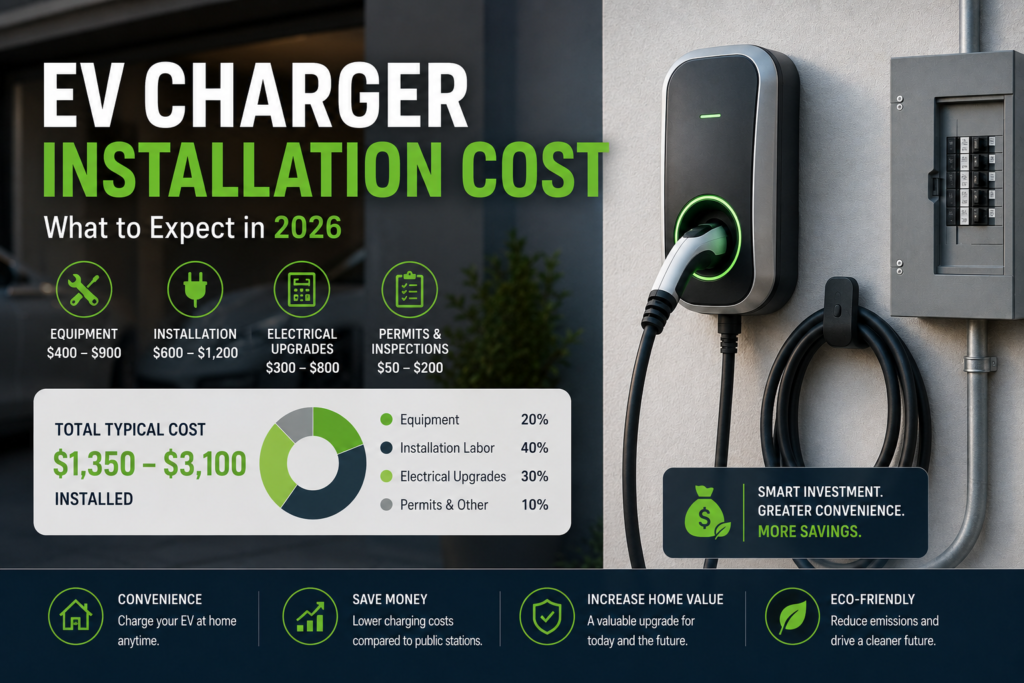

EV charger installation cost ranges from $0 to roughly $4,500. It depends on which charging level you’re installing, and what your panel already supports.
Level 1 charging uses the outlet already in your garage, so there’s nothing to install or pay for. Level 2 charging, the setup most EV owners choose, typically runs $800 to $3,000 for a straightforward job. Costs can climb past $4,000 if your home needs a full service upgrade. Level 3, or DC fast charging, isn’t something anyone installs at a house. The hardware alone starts around $38,000, built for commercial sites and highway stops, not driveways.
EV charger installation cost is really shorthand for three separate jobs, not one. It covers the electrician’s labor, any panel work your home needs, permits, and sometimes the charger hardware itself. The number changes completely depending on whether you’re talking about Level 1, Level 2, or Level 3 charging. That’s the first thing to nail down.
Level 1, Level 2, or Level 3: Which One Are You Even Pricing?
Level 1 charging plugs straight into a standard 120-volt household outlet. It’s the same kind your washing machine uses. It adds roughly 3 to 5 miles of range per hour, which sounds slow because it is. For a plug-in hybrid, or a driver who covers under 30 miles a day, that’s plenty. An overnight Level 1 charge covers the need completely. It costs nothing beyond the cable that came with the car.
Level 2 charging is what most people actually mean when they search for EV charger installation cost. It runs on a 240-volt circuit, the same type that powers an electric dryer. It adds 20 to 44 miles of range per hour, depending on the charger and your car’s onboard capacity.
That’s the difference between waking up to a full battery and waking up to a half-full one. If you’ve already decided Level 2 is the right call, we’ve got you covered. Our full Level 2 installation cost breakdown covers panel sizing, circuit amperage, and permit specifics in more depth.
Level 3, or DC fast charging, doesn’t belong on this list at all. It requires three-phase power that most homes don’t have. The hardware alone runs from $38,000 to well over $90,000 per connector. That’s a commercial investment, not a home upgrade. We won’t spend more time on it here.
What Actually Drives the Price
Two homes with identical Level 2 chargers can end up with wildly different bills. The gap almost always comes down to the same handful of variables. Panel capacity matters most. If your panel already has an open slot and enough spare capacity, installation is usually simple. That capacity needs to cover a 40 to 48-amp circuit. If it doesn’t, you’re looking at a subpanel or a full service upgrade. That single factor explains most of the spread between low and high quotes.
Distance is the second big driver. A charger installed a few feet from the panel needs a short wire run and minimal labor. One installed in a detached garage needs conduit, possibly trenching, and several more hours of labor. Indoor installations also tend to run cheaper than outdoor ones. Outdoor setups need weatherproof conduit and exterior-rated boxes to keep moisture out.
Finally, there’s the question of a plug-in setup versus a hardwired one. A plug-in charger connects to a NEMA 14-50 outlet, similar to what an RV uses. It’s generally cheaper, and easier to move later. A hardwired unit connects directly to the circuit, with no outlet in between. Some smart chargers require this for their full feature set. It typically adds a bit to labor, without adding much to actual performance.
Cost by Scenario
| Scenario | Estimated Total Cost |
|---|---|
| Level 1 (existing outlet, no new work) | $0 |
| Level 2, plug-in, panel has spare capacity | $800–$1,200 |
| Level 2, new circuit, standard indoor run | $1,000–$1,800 |
| Level 2, subpanel required | $1,500–$2,800 |
| Level 2, full panel or service upgrade | $2,500–$4,500+ |
| Outdoor or long wiring run (add-on) | +$200–$2,000 |
Permits typically add another $50 to $300, depending on jurisdiction. Most localities require one for any new 240-volt circuit, even if your electrician doesn’t mention it upfront.
Where You Live Changes the Number
Electrician labor rates aren’t uniform across the country. The gap is bigger than most people expect. Installers in California and New York generally charge 30 to 45% more than the national average. That can push a $1,200 job toward $1,700 or higher, before any panel work is factored in.
Installers in several Southern states run 8 to 12% below average. The identical job might land closer to $1,000 there. If you’re comparing quotes from a national chain against a local electrician, factor in where you live.
The federal Section 30C tax credit covered 30% of installation costs, up to $1,000. It applied only to installations completed by June 30, 2026. It’s no longer available for new projects. State and utility rebates weren’t affected by that change, and they vary enormously by territory. It’s worth checking what your utility offers before you assume you’ll pay full price.
Which Level Should You Actually Install?
This is the question the broad searches don’t answer, and it’s worth settling before you request a single quote. If you drive under 30 miles a day, or lease your car, Level 1 genuinely covers most driving patterns. The same goes for plug-in hybrids with a small battery. Spending $1,500 on Level 2 buys convenience you might not actually need.
If you drive a typical daily commute in a full battery-electric vehicle, that changes fast. Most EV batteries take 20-plus hours to fill from a standard outlet. That doesn’t fit a normal overnight window, so Level 2 stops being optional.
Renters and frequent movers face a different calculus. A plug-in Level 2 setup keeps the investment portable in a way a hardwired unit doesn’t. Condo and apartment dwellers have it harder still. You don’t own the panel, so installation needs landlord or HOA approval first. Portable Level 1 charging is often the realistic starting point until that conversation happens.
Common Mistakes We See
Homeowners frequently accept a quote that only covers the charger and basic labor. Then they’re surprised when the electrician discovers the panel needs work mid-job. Ask for a load calculation before any final number gets quoted, not after.
Skipping the permit is another common mistake. It feels like a shortcut, but an unpermitted 240-volt circuit can complicate things later. It can hold up a home sale or an insurance claim.
Plenty of people also forget to check utility rebates entirely. That leaves real money on the table, since state incentives often outlast federal ones.
FAQ
Sometimes. Quotes from electricians usually cover labor and materials only, with the charger unit priced separately at $400 to $900. Always confirm whether hardware is bundled in before comparing quotes.
The circuit work requires a licensed electrician in nearly every jurisdiction. It’s a dedicated 240-volt circuit, not a place to cut corners. Mounting the charger unit itself is sometimes DIY-friendly, but the wiring isn’t.
A straightforward Level 2 job typically takes 4 to 8 hours in a single visit. Panel upgrades add a second visit, and sometimes a wait for utility coordination.
For low-mileage drivers and plug-in hybrids, yes. For a daily-driven full EV, it’s usually a stopgap rather than a long-term plan.
In nearly all US jurisdictions, yes. A dedicated 240-volt circuit counts as permitted electrical work. Skipping it can create problems later, even if the install itself is done correctly.
Advertised prices are almost always equipment-only, or based on best-case labor. The real number depends on your panel capacity, wiring distance, and local labor rates. That’s exactly why we broke down the scenario table above.
Final Thoughts
The honest takeaway is that EV charger installation cost isn’t one number. Anyone quoting you a flat price before seeing your panel is guessing. Get the load calculation done first. Decide honestly whether you even need Level 2. Check your utility’s rebate page before assuming the federal credit’s expiration means full price. Most homeowners land somewhere in the $800 to $2,000 range once the guesswork is removed. It’s the panel upgrades and long wiring runs that push a handful of installs well past that.

Rana Muzammil is a Computer Science graduate and the founder of EVGroundTruth.com. He applies software analytics and data research to evaluate battery performance, charging infrastructure, and real-world EV metrics. His mission is to provide honest, fact-checked automotive insights free of marketing hype.