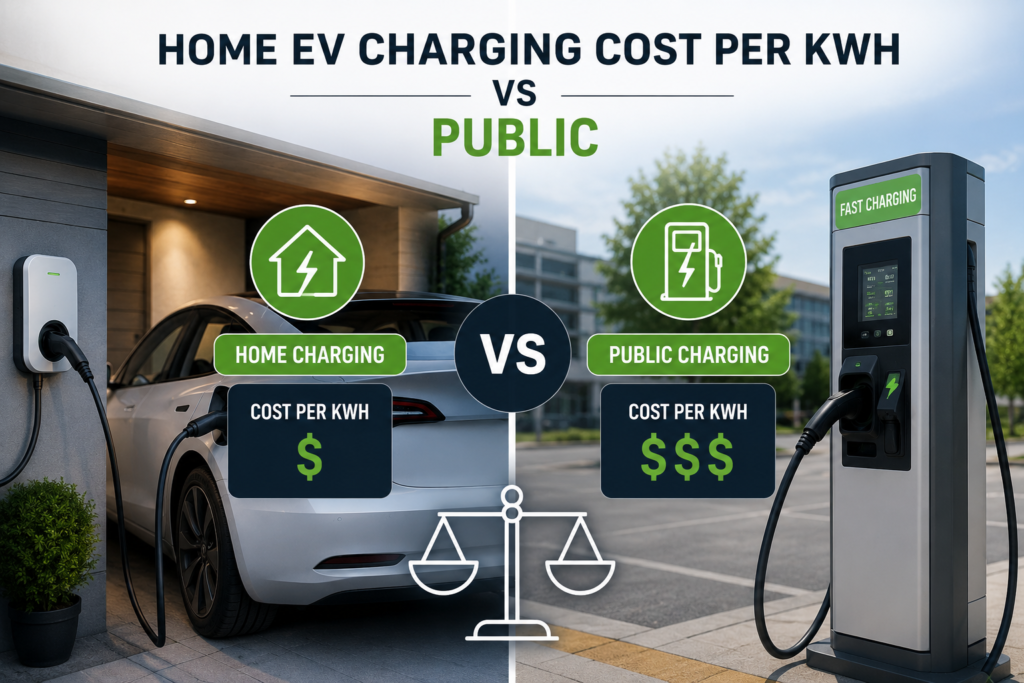

Home EV charging cost per kWh vs public shows a wide, consistent gap. Home charging averages 18.4 cents per kWh nationally. Public Level 2 charging runs 20 to 35 cents per kWh, set by whoever hosts the station.
Public DC fast charging runs 30 to 60 cents per kWh. It can reach 85 cents in high-cost states like California or Hawaii. That means public fast charging typically costs two to four times more than plugging in at home. The gap isn’t a pricing trick — it reflects real costs public networks carry that your garage outlet doesn’t.
This comparison is about the rate itself, not your total bill. It’s the same cents-per-kWh number gas prices show at the pump, just for electricity instead. It applies no matter which EV you drive. The rate is set by where you plug in, not what you’re charging.
Home Charging: One Predictable Rate
Home charging is the simplest side of this comparison. You pay whatever your utility bills you. That averages 18.4 cents per kWh across the US, per EIA data. That rate holds steady no matter how often you charge, powering your refrigerator and your lights the same way. The only real variable is which state you live in. Hawaii residents pay well over 35 cents per kWh at home. Parts of the Pacific Northwest pay under 12 cents.
Public Charging: A Wider, Messier Range
Public charging splits into two very different categories. Level 2 stations, found at malls or workplaces, typically charge 20 to 35 cents per kWh. Networks like ChargePoint let the property host set that price, so it varies station to station. DC fast charging costs considerably more, typically 30 to 60 cents per kWh. In expensive states, non-member DC fast rates can climb past 80 cents per kWh. Non-Tesla vehicles using a Supercharger via an adapter usually pay a bit more per kWh than Tesla owners do. Membership plans, usually $4 to $15 a month, shave 10 to 15 cents off that per-kWh rate.
Rate Comparison by Charging Type
Here’s the full breakdown, side by side. These are 2026 published network rates, not per-minute conversions or outdated averages. Your local price may run a bit higher or lower depending on your specific station.
| Charging Type | Typical Rate (per kWh) | Notes |
|---|---|---|
| Home (national average) | $0.184 | Varies by state, roughly $0.10–$0.40+ |
| Public Level 2 (ChargePoint, FLO, Blink) | $0.20–$0.35 | Host sets the price; varies station to station |
| Tesla Supercharger | $0.25–$0.50 | Often the cheapest DC fast option |
| EVgo | $0.35–$0.44 | Membership lowers the rate |
| Electrify America | $0.43–$0.60 | Up to $0.85 in high-cost states; membership cuts ~$0.10 |
| NEVI-funded stations | $0.25–$0.35 | Newer, federally mandated transparent per-kWh pricing |
Every network above bills higher than your home rate, without exception.
The Same 50 kWh, Three Different Prices
Let’s make this concrete with one battery, charged three different ways. Say you need to add 50 kWh, roughly a week’s driving for a Chevy Bolt owner.
At home, 50 kWh at the national average rate costs $9.20. On a public Level 2 charger at 28 cents per kWh, the same 50 kWh costs $14. On a non-member Electrify America charger at 50 cents per kWh, that same 50 kWh jumps to $25.
Same battery, same energy, a $16 spread depending only on where you plugged in. That’s the entire home-versus-public comparison in one example.
Why Public Charging Costs More
Public networks carry costs your home outlet never will. They pay commercial electricity rates, which run higher than residential rates in most states. They also pay demand charges. That’s a separate fee utilities add when a station draws a lot of power in a short burst. DC fast chargers do exactly that, constantly. On top of that, the network covers real estate, hardware, and staff. It still needs to turn a profit.
There’s also the reality of underused hardware. A DC fast charger sits idle for stretches of the day. The network still pays for the land lease and grid connection either way. Home charging never has that problem, since your outlet already exists for the rest of your house.
When a Membership Actually Pays Off
Electrify America’s Pass+ membership costs $4 a month and cuts your rate by roughly 10 cents per kWh. Break-even math is simple: $4 divided by $0.10 per kWh equals 40 kWh. Charge more than 40 kWh in a month on that network, and the membership already paid for itself. That’s roughly one 10-80% fast charge on a mid-size EV. For occasional road-trippers, staying non-member and paying full price is usually still fine.
EVgo and ChargePoint offer similar plans, usually $5 to $10 a month for a few cents off per kWh. The math works the same way: divide the monthly fee by your per-kWh savings to find your break-even point. If you rarely use public fast charging, skip the membership entirely.
Common Mistakes People Make Comparing These Rates
Drivers often compare a single public fast-charging session to their entire home charging bill, which isn’t a fair comparison. Compare rate to rate, cents per kWh to cents per kWh, not one bad day to a full month. Another mistake is ignoring idle fees. Some networks charge up to a dollar a minute if you leave your car plugged in after it’s done. Plenty of people also never check whether their state allows per-kWh billing. A few states still require per-minute pricing instead. That structure can penalize slower-charging cars.
FAQ
Almost always, yes. The rare exception is a free workplace or retail Level 2 charger. That beats even the cheapest home rate.
Tesla adjusts pricing by location and time of day, similar to airline pricing. Off-peak hours and lower-demand stations can drop well under the network average.
Only if you charge on that network often enough to hit the break-even point. Occasional road-trippers usually come out ahead paying non-member rates instead.
Yes, generally. Level 2 stations deliver power more slowly, which costs the network less to provide. That savings usually passes through to the rate you pay.
They can, especially at busy stations. Factor them in if you tend to leave your car plugged in past the charge finishing.
A handful of states still restrict who can legally sell electricity by the kilowatt-hour. Networks in those states bill by time instead, which can unfairly penalize EVs that charge more slowly.
Not usually. Most hotel and residential Level 2 chargers bill at the host’s own rate, often free or near home pricing. True public network pricing only applies to commercial networks like the ones in our table.
Final Thoughts
Home EV charging cost per kWh vs public isn’t really a close contest. Home charging wins on price every time you can plug in at your own outlet. Public charging still beats gasoline per mile in almost every state, even at the highest DC fast rates. The honest takeaway is to treat public fast charging as a road-trip tool, not a daily habit. Do that, and the rate gap barely touches your actual monthly bill.

Rana Muzammil is a Computer Science graduate and the founder of EVGroundTruth.com. He applies software analytics and data research to evaluate battery performance, charging infrastructure, and real-world EV metrics. His mission is to provide honest, fact-checked automotive insights free of marketing hype.