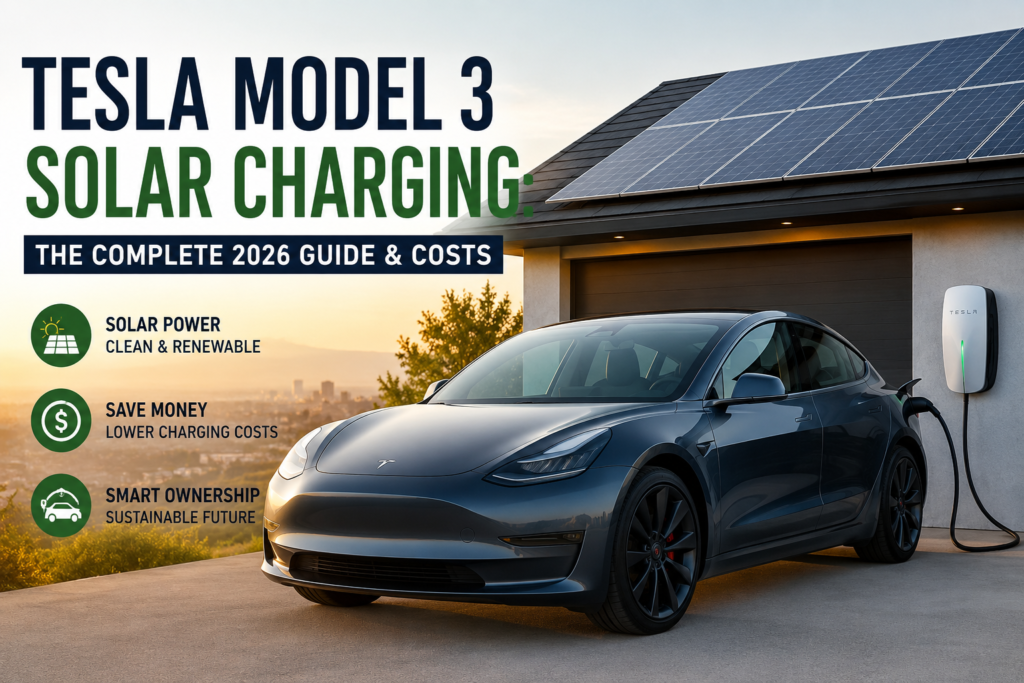

Most people who search for Tesla Model 3 solar charging are picturing something that doesn’t exist: solar panels built into the roof of the car itself. That’s not what this is. Tesla Model 3 solar charging is really about connecting your home’s solar system to your car’s charger, so the electricity filling your battery comes from sunlight instead of the grid. Done right, it can push your cost per mile close to zero. Done without understanding the hardware first, it’s easy to spend thousands of dollars on a setup that never actually talks to your car the way you expected.
This guide covers what Tesla’s official solar charging feature requires, what it costs to set up in 2026, how many panels you actually need, and where most owners get it wrong.
What “Tesla Model 3 Solar Charging” Actually Means
Tesla has never sold a Model 3 with panels on the car. The Cyber truck got an experimental solar tonneau cover concept a few years back — the Model 3 never did, and there’s no indication that’s changing. So when people talk about solar-charging a Model 3, they mean one of two setups:
A home solar array feeding a Tesla Powerwall, which then powers a Wall Connector that charges the car. Or a home solar array feeding the grid directly (no battery), with a smart charger timing the car’s charging session to match periods of high solar output.
The difference between those two setups matters more than most articles let on, because it determines which hardware — and which Tesla feature — actually applies to you.
How Tesla’s Official “Charge on Solar” Feature Works
If you already own Tesla solar panels and a Powerwall, Tesla built a feature specifically for this. It’s called Charge on Solar, and it lives inside the Tesla app under your vehicle’s charging settings.
Here’s what it requires, at minimum:
- A Model S, 3, X, Y, or Cybertruck running software 2023.32 or later
- A Powerwall with solar on-site, running firmware 23.12.10 or later
- Tesla app version 4.30.5 or later
Once it’s set up, you get a “sun slider” next to your normal charge limit. Drag it, and you’re telling the car: charge to this level using grid + solar as needed, then switch to solar-only until you hit your full charge limit. The system recalculates how much excess solar is available roughly every ten seconds, so it’s constantly adjusting rather than running as a flat on/off switch.
Tesla expanded this in 2026 with Enhanced Charge on Solar, which layers in Wall Connector’s Low Cost Charging mode — the car will now charge whenever there’s excess solar or whenever your utility rate drops to its cheapest window, whichever gets you a full battery for less.
The catch: none of this works without a Powerwall. That single requirement trips up more people than anything else in this whole topic.
What If You Don’t Have a Tesla Powerwall?
This is the situation most Model 3 owners are actually in — solar panels on the roof, no battery, and a car that Tesla’s own app won’t let them “solar charge” through the official feature.
You’ve still got real options. Solar-aware Level 2 chargers from other manufacturers work with any inverter brand, Tesla or not:
- Wallbox Pulsar Plus runs an “Eco-Smart” mode with two settings — Full-Green (charge only on 100% solar) and Eco (a blended mix) — and costs roughly $600–$700 before installation.
- Enphase IQ EV Charger integrates tightly with Enphase microinverter systems and dynamically matches charging speed to real-time solar output.
There are also subscription bridge services that connect Tesla’s charging API to non-Tesla solar systems — Charge HQ is the best-known example. Worth flagging: Charge HQ has announced it’s shutting down as of September 7, 2026, so if you’re researching this route right now, check its replacement or migration path before building a workflow around it.
How Many Solar Panels Do You Actually Need for Model 3 Solar Charging?
This is where the math gets specific enough to actually be useful.
The average American drives about 37 miles a day. The Model 3 uses roughly 0.25–0.28 kWh per mile depending on trim and driving conditions, which works out to somewhere around 9–10 kWh of daily energy use just for driving. At 5 peak sun hours (a reasonable US average) and using standard 410W panels, that lands you at about 6 solar panels dedicated to covering the car alone — separate from whatever your home already needs.
Different calculators land anywhere from 5 to 8 panels depending on your location’s sun hours and the exact panel wattage used, but 6 is the number that keeps showing up across 2026 solar-EV calculators specifically for the Model 3, since it’s one of the more efficient EVs on the road.
If you drive more than the national average — a longer commute, regular road trips — scale that number up proportionally. Someone driving 60 miles a day should budget for closer to 9 or 10 panels just for the car.
The Real Cost of Solar-Charging a Model 3 in 2026
| Option | Estimated Installed Cost (2026) | Federal Tax Credit | Who Receives the Credit | Best Suited For |
|---|---|---|---|---|
| Whole-home solar (cash or loan purchase) | $2.50–$3.50 per watt | None — Section 25D expired December 31, 2025 | Not applicable | Homeowners already planning whole-house solar, with EV charging as a secondary benefit |
| Small EV-only solar add-on (approx. 2.5 kW) | $6,000–$9,000 | None | Not applicable | Not recommended as a standalone investment in 2026 |
| Solar plus Powerwall (Tesla Charge on Solar) | Additional $9,000–$11,000 on top of base solar cost | None | Not applicable | Existing Tesla ecosystem owners who want automated solar-priority charging |
| Standalone Level 2 charger (e.g., Wallbox Pulsar Plus) | $900–$1,500 | None (not solar-linked) | Not applicable | Homeowners with existing solar panels who want scheduled or off-peak charging |
| Lease or PPA solar (third-party owned) | No upfront cost; fixed monthly payment | Yes — Section 48E, available through December 31, 2027 | Leasing or installation company (savings passed to homeowner via lower payment) | Homeowners who still want a federal-credit-linked discount without direct ownership |
| System installed before December 31, 2025 | Not applicable | Yes — 30 percent, claimable on 2025 tax return | Homeowner | Homeowners who completed installation before the deadline |
Summary
| Scenario | 2026 Financial Reality |
|---|---|
| Installing solar solely to power an EV | Weaker financial case than in 2024 or 2025, due to the loss of the federal credit |
| Installing solar for the whole home, with EV charging included | Still financially sound; the added cost for EV capacity is marginal |
| Seeking any federal discount in 2026 | Only available through lease or PPA arrangements under Section 48E |
Ways to Charge Your Tesla Model 3 With Solar (Comparison)
| Tesla Charge on Solar | Third-Party Smart Charger | Grid-Only Level 2 (baseline) | |
|---|---|---|---|
| Requires a Powerwall | Yes | No | No |
| Works with any solar brand | No — Tesla ecosystem only | Yes | N/A |
| Typical setup cost | $9,000–$11,000+ (Powerwall) if not already owned | $900–$1,500 (charger + install) | $300–$800 (charger + install) |
| Automation level | Fully automatic, app-controlled | Automatic, app-controlled | Manual or basic schedule only |
| Approx. cost per mile | Near-zero on excess solar | $0.03–$0.05 | $0.04–$0.06 (grid-rate dependent) |
| Best for | Existing Tesla Solar + Powerwall owners | Owners with non-Tesla solar wanting automation | Anyone without solar, or as a cost baseline |
Step-by-Step: Setting Up Solar Charging on Your Model 3
Step 1: Confirm what hardware you actually have
Check whether your home has solar panels, whether they’re tied to a battery (Powerwall or otherwise), and what brand of inverter is installed. This single check determines your entire path forward.
Step 2: Match your hardware to the right charging method
Tesla solar + Powerwall → use Charge on Solar in the Tesla app directly. Non-Tesla solar, no battery → look at a solar-aware Level 2 charger like the Wallbox Pulsar Plus or Enphase IQ. No solar yet → decide whether you’re solving for “cheaper charging” (a standard Level 2 charger and time-of-use scheduling) or “solar charging” specifically, since those are different projects with very different price tags.
Step 3: Set your charge limit and solar threshold
If you’re on Charge on Solar, this is the sun slider — set it to cover your daily minimum (say, 50%) from grid + solar, then let solar-only take you the rest of the way. On third-party chargers, this is usually an Eco/Green mode toggle in the manufacturer’s app.
Step 4: Monitor for the first two weeks
Solar output is genuinely unpredictable — a cloudy week can leave your car underpowered if you set your thresholds too aggressively. Watch your actual charge levels for the first couple of weeks and adjust the slider or schedule rather than assuming the default settings are right for your climate.
Common Mistakes People Make With Model 3 Solar Charging
Assuming Charge on Solar works without a Powerwall. It doesn’t, full stop. This is the single most common point of confusion, and it’s usually discovered only after someone’s already bought solar panels expecting the feature to just appear in their app.
Under sizing the array. Basing panel count only on the car’s needs and forgetting the home’s existing electricity use means the “excess” solar available for the car ends up much smaller than expected.
Ignoring the charger’s amperage limit. A Level 2 charger rated below your car’s max AC intake won’t bottleneck safety, but it will slow your charging speed — worth checking against your panel/inverter output before you buy.
Building a workflow around a subscription bridge app without a backup plan. As the Charge HQ shutdown shows, these third-party services aren’t guaranteed to be around long-term.
FAQ
Does the Tesla Model 3 have solar panels built into it?
No. Tesla has never offered factory solar panels on the Model 3. “Solar charging” refers to home solar powering your charger, not panels on the vehicle.
Can I do Tesla Model 3 solar charging without a Powerwall?
Yes, but not through Tesla’s own Charge on Solar feature, which requires one. You’ll need a third-party solar-aware Level 2 charger instead, such as the Wall box Pulsar Plus or Enphase IQ EV Charger.
How many solar panels do I need for Tesla Model 3 solar charging specifically?
For the average US commute of about 37 miles a day, roughly 6 panels (410W) at typical peak sun hours will cover the car’s energy use — separate from whatever your home already needs.
Is charging a Model 3 on solar actually free?
Close to it, once the system is paid off. The marginal cost of charging on genuinely excess solar is near zero, but the panels, inverter, and (if applicable) Powerwall still have a real upfront cost and payback period.
Do I still get a tax credit for adding solar to charge my EV in 2026?
Not the federal residential credit — Section 25D expired December 31, 2025, for cash and loan-financed systems. Some state programs and commercial/lease structures still offer incentives, so it’s worth checking what’s available where you live.
How long does it take to fully charge a Model 3 on solar alone?
It depends entirely on panel output and weather, but on a Level 2 charger accepting up to 11 kW, a full charge from empty takes roughly 6–7 hours under ideal, uninterrupted solar production — longer on partly cloudy days.
Final Thoughts
If you already own Tesla solar and a Powerwall, turning on Charge on Solar is close to a no-brainer — it’s a free feature sitting in an app you already have. If you’re starting from zero purely to solar-charge a Model 3, the math is genuinely tighter in 2026 than it was before the federal credit expired, and we’d rather tell you that upfront than sell you on a payback period that doesn’t hold up. The setup makes the most financial sense when it’s an extension of a home solar decision you were already leaning toward — not a standalone project built around one car.

Rana Muzammil is a Computer Science graduate and the founder of EVGroundTruth.com. He applies software analytics and data research to evaluate battery performance, charging infrastructure, and real-world EV metrics. His mission is to provide honest, fact-checked automotive insights free of marketing hype.