
Quick verdict: The Emporia Classic is one of the best value smart chargers on the market right now. It’s 48-amp hardwired power, real load-sharing tech, and a starting price under $500. It’s not the flashiest charger out there. For most homes, though, it’s the smart pick.
Most EV chargers in this price range cut a corner somewhere. Emporia Classic Level 2 EV Charger didn’t. That’s really the whole story with the Classic, and it’s worth unpacking why.
What You Actually Get: Full Specs
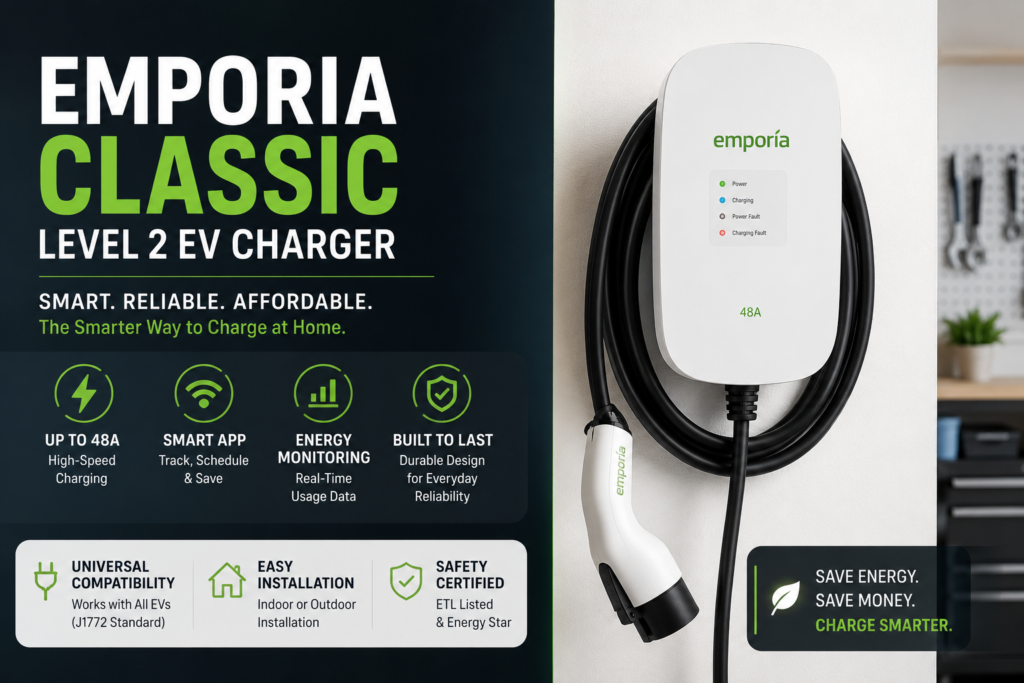
The Emporia Classic delivers 48 amps and 11.5 kW when hardwired. Plug it into a NEMA 14-50 outlet instead, and you get 40 amps and 9.6 kW. Either setup charges most EVs fully overnight, adding roughly 40 miles of range per hour of charging.
The cable runs 25 feet, long enough to reach most driveways without an awkward parking angle. The enclosure carries a NEMA Type 4 watertight rating, so outdoor mounting is genuinely fine, not just technically allowed.
Connectivity runs through 2.4GHz WiFi and Emporia’s own app. From there you get charge scheduling, time-of-use rate programming, monthly usage reports, and real-time monitoring.
It’s UL certified with built-in GFCI protection, which matters more than it sounds. That’s the safety feature that shuts power off instantly if it detects a fault.
One feature worth calling out on its own: Intelligent Load Sharing. Say you install two or more Emporia chargers on the same circuit — a two-EV household, for example.
They automatically split available power instead of tripping a breaker. Most chargers in this price bracket don’t offer that at all.
Pricing starts at $449 for the J1772 version, or $479 for the NACS version built for Tesla-style ports. You can check current pricing and buy directly from Emporia.
Pros and Cons:
What’s genuinely good:
The price-to-feature ratio is hard to beat. Load sharing at this cost is rare. The app is clean and doesn’t nag you to upgrade to a paid tier. It’s earned real recognition too.
MotorTrend, InsideEVs, and Good Housekeeping have all named it a top pick, not just marketing copy from Emporia itself.
What holds it back:
It maxes out at 48 amps. If you’re chasing the fastest possible home charging speed, ChargePoint’s 50-amp option edges it out slightly. The cable is fixed-length, not retractable, so cable management is on you. And it’s a newer brand than Tesla or ChargePoint. That matters if brand longevity is a real concern for your warranty.
How the Emporia Classic Level 2 Charger Compares:
| Feature | Emporia Classic | ChargePoint Home Flex | Tesla Wall Connector |
|---|---|---|---|
| Price | $449–$479 | $549–$699 | $475 (NACS) / $595–$650 (Universal) |
| Max Power | 48A / 11.5 kW | 50A / 12 kW (adjustable) | 48A / 11.5 kW |
| Cable Length | 25 ft | 23 ft | 24 ft |
| Install Options | Hardwired or plug-in | Hardwired or plug-in | Hardwired only |
| Multi-Charger Load Sharing | Yes | No | Yes (Tesla units only) |
| Best For | Value-focused buyers | Any EV brand, adjustable panels | Tesla-only households |
The Honest Read:
ChargePoint wins on raw flexibility. Tesla wins if you’re Tesla-only and want the tightest ecosystem fit. The Emporia Classic wins on value, full stop. Nobody else in this comparison gives you load sharing and a sub-$500 price at the same time.
Who This Charger Is Actually Best For ?
This is the charger for someone who wants genuinely good hardware without paying a premium for a name. It’s also the strongest pick we’ve seen for two-EV households. The load-sharing feature solves a real problem most budget chargers ignore entirely.
It’s a weaker fit if you’re chasing the absolute fastest charge time above all else. Same goes if you’re deeply invested in one specific EV brand’s ecosystem and want everything under one app.
Before You Buy: What to Check First!
Confirm your panel can support it.
A 48-amp charger needs a 60-amp breaker to run safely at full output, per NEC code. If your panel is already near capacity, an electrician needs to check this before you order anything. Our Level 2 EV charger installation cost guide breaks down exactly what that typically runs.
Decide hardwired vs. plug-in now, not later.
Hardwiring is the more permanent, slightly more weatherproof option. A NEMA 14-50 plug-in setup is easier to remove if you move or upgrade later. Both work fine with the Classic. Pick based on your situation, not just habit.
Don’t skip the permit.
Even a straightforward install needs a permit and inspection in nearly every US jurisdiction. Skipping it risks problems at your next home sale or insurance claim.
FAQ
Yes. It’s one of the best value options available. It combines 48-amp charging, load sharing, and a sub-$500 price few competitors match.
At 48 amps, it adds roughly 40 miles of range per hour. That’s enough for a full overnight charge on nearly any EV.
Not safely, and not legally in most places. It runs on a 240-volt circuit, which requires a licensed electrician and a permit.
Yes. The J1772 version works with every EV except Tesla. The NACS version is built specifically for Tesla-style ports.
It depends on your priority. ChargePoint offers slightly more power and works with any panel size through adjustable amperage. Emporia costs less and includes load sharing, which ChargePoint doesn’t offer.
Final Verdict
The Emporia Classic earns its reputation. It’s not trying to be the fastest or the flashiest charger on the market. It doesn’t need to be. For the price, the feature set — especially load sharing — is genuinely hard to beat. If you’re not locked into one EV brand’s ecosystem and want reliable hardware without overpaying, this is the pick. We’d point a friend here first.

Rana Muzammil is a Computer Science graduate and the founder of EVGroundTruth.com. He applies software analytics and data research to evaluate battery performance, charging infrastructure, and real-world EV metrics. His mission is to provide honest, fact-checked automotive insights free of marketing hype.